The ADIPEC Awards 2023 has honoured eight pioneering projects, companies and individuals who are driving transformative change across the global energy system. The winners represent companies and individuals from the United Arab Emirates, Malaysia, the United Kingdom, Israel, and the United States.
Held under the theme, ‘Leading the Transformation’, the 13th ADIPEC Awards Ceremony recognised outstanding achievements within the wider energy sector and celebrated global innovators in their pursuit of net-zero emissions, decarbonisation and an equitable energy transition through eight award categories.
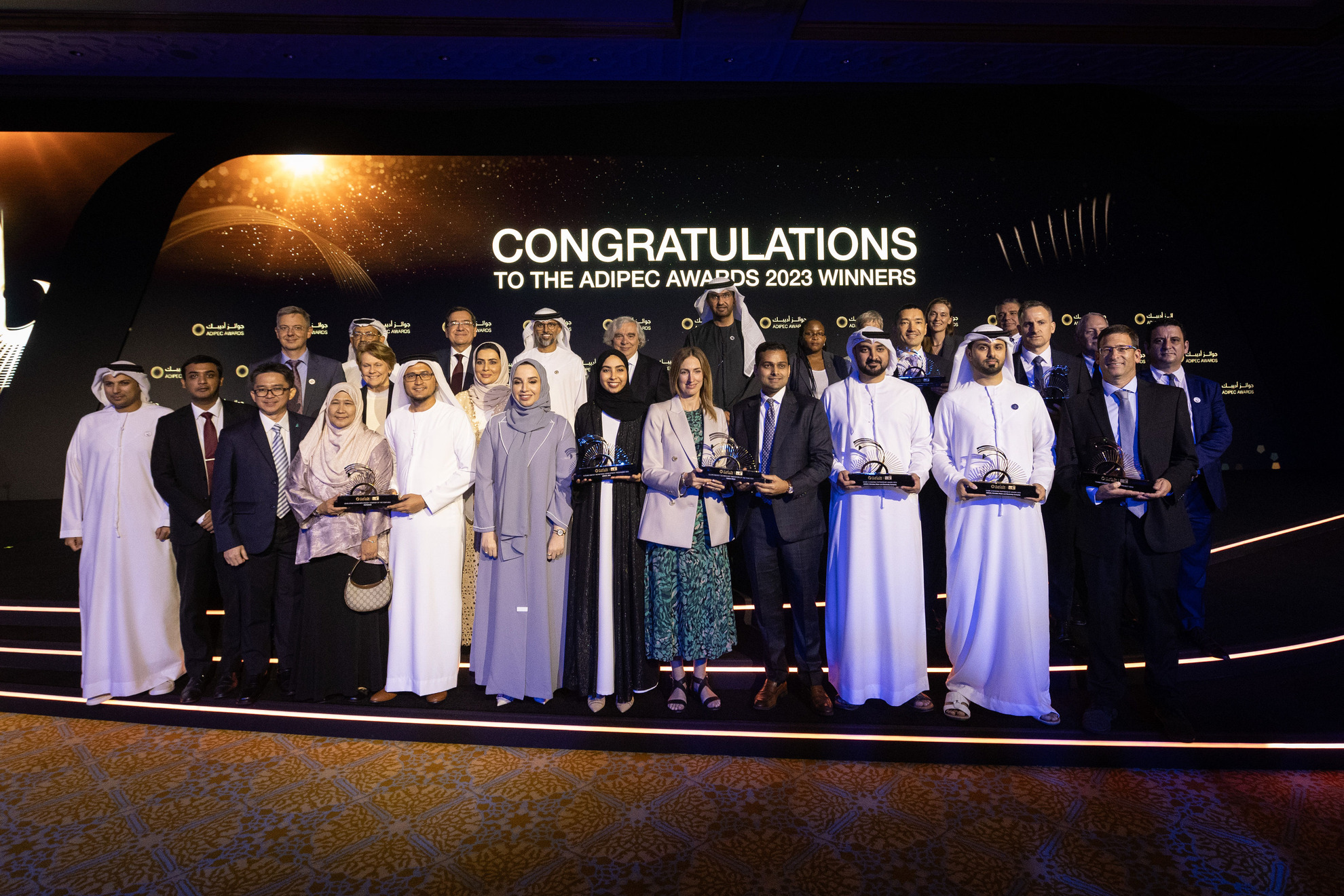
The awards ceremony, which took place at the Emirates Palace Hotel, in Abu Dhabi, capital of the United Arab Emirates, was attended by leaders and dignitaries from across energy, technology and government.
His Excellency Suhail Mohamed Al Mazrouei, UAE Minister of Energy and Infrastructure and ADIPEC Awards 2023 Juror, said: “In this, the UAE’s Year of Sustainability, we are proud the ADIPEC Awards has drawn some of the world’s most innovative and forward-thinking companies and individuals to demonstrate their leadership in advancing the energy transition.
“The world is in need of urgent and tangible solutions to the challenges of climate change and decarbonisation and these awards continue to evolve to showcase the leadership in innovation and collaboration to drive the industry forward.”
Fatema Al Nuaimi, chairperson of ADIPEC Awards 2023 and executive vice president of downstream business management at ADNOC, said: “This year’s ADIPEC Awards honoured companies and individuals who are playing a critical role in leading the global energy transition. The winners will inspire other innovators across the energy sector and encourage them to strengthen their efforts to enable a more sustainable global energy system.”
Leader of Change – Passionate Driver of Progress Award honoree, Professor Ernest J. Moniz, CEO of the US-based Energy Futures Initiative is a leading voice on energy innovation pathways and international security matters. Professor Moniz has worked across academia, research, government, and the non-profit sector to amplify and elevate climate mitigation and clean energy in government and the scientific community.
In his acceptance speech, Professor Moniz said: “I am very pleased to receive this award on behalf of my colleagues who I have worked with in academia, government, and the private sector. It is particularly special to receive this award here in the UAE in its year of COP28, which under the leadership of Dr Sultan [Al Jaber], looks to set a new standard for pragmatism and results, bridging the needs of the developed world and the global south. This has been the dominant theme of what I’ve been doing for decades and what are the objectives of COP28.”
Meanwhile, the Young Changemaker of the Year Award – was given to Lee Kian Seng, product manager, technology digital solutions at PETRONAS, Malaysia. Seng has been driving transformative changes across various roles in PETRONAS, leading big-data analytics projects in the domain of production yield optimisation, energy optimisation and plant start-up execution.
The United Kingdom and Northern Ireland’s Carbon Clean company won the Clean Energy Technology Innovation of the Year Award for its CycloneCC, an innovative technology that reduces the cost and physical footprint of carbon capture by over 50 percent. As a standardised and modular solution, it allows for scalability and rapid adoption, bringing carbon capture within reach of many more hard-to-abate industries.
The American LanzaTech company received the Decarbonisation at Scale Award for its innovative carbon capture process that has been deployed at three commercial sites in China, in partnership with Shougang. The process captures all produced CO2 and transforms it into sustainable fuels and chemicals, reducing emissioins and creating a new circular carbon economy.
Malaysia’s PETRONAS Research was named the ADIPEC Awards Developing Economies Energy Company of the Year for its innovative technology solution to capture and monetise stranded high carbon dioxide fields in developing countries. Stranded natural gas reserves of over 50 trillion cubic feet remain undeveloped due to high CO2 content and contaminants, making them uneconomical to develop. PETRONAS has developed a technology solution using carbon capture, utilisation and storage and separation of liquid CO2 to create a new product.
The Future Energy Workforce Development Programme Award was presented to ADNOC for its Energy Futures Initiative. The initiative is a joint strategic workforce development programme by ADNOC and SLB which utilises innovative methodologies and technologies, including artificial intelligence-powered talent analytics to create a competitive advantage in a fast-paced labour market.
Israel’s H2Pro received the Transformative Hydrogen Project for its E-TAC methodology, which produces green hydrogen at 95 percent energy efficiency, compared to the 60-70 percent efficiency of conventional electrolysis. H2Pro claims its E-TAC electrolysers can deliver the lowest levelised cost of hydrogen.
The Game-Changing Partnership Award was awarded to ADNOC Onshore and the Emirates Water and Electricity Company (EWEC) for their partnership that is enabling ADNOC Onshore to source its grid power from renewable energy, supporting the decarbonisation of its operations.
This year’s ADIPEC Awards attracted a record-breaking 1,072 entries from 78 countries and reflected a wide spectrum of geographies, industries and companies. It featured all new categories, introduced to address key global challenges in universal access to cleaner and more secure energy, and to a faster energy transition.
The ADIPEC Awards are a highlight of ADIPEC, the world’s largest energy conference and exhibition, which is taking place in Abu Dhabi from 2-5 October, uniting industries to accelerate collective, responsible action, decarbonise quicker and future-proof the energy system. Taking place under the theme of ‘Decarbonising. Faster. Together.’, ADIPEC 2023 is focused on bringing together the ideas, ambition, technology and capital needed to accelerate urgent, collective and responsible action to decarbonise quicker and future-proof our energy system.
For more information visit www.adipec.com