Vesta Terminals appoints new CEO

On the 1st of December 2022, Mr. Xinghong Liu was appointed as CEO of Vesta Terminals BV. This new leadership is aiming to take our company to new heights as Vesta 2.0 with great performance and sustainability in the coming years with joint efforts of all employees.

In order to achieve our goals, we would like to create a team of effectiveness, unity, mutual respect and professionalism.

As from the 1st of January 2023, the Management Team of Vesta Terminals has changed:

??? – Xinghong Liu
??? – Helen Huang
??? – Geert Arnoldussen
??? – Daan Schutte
?? ???????? – Myriam Pieters
????????? ???????? – Peter Wahlström

For more information visit www.vestaterminals.com

First LNG cargo arrives at Germany’s LNG terminal in Wilhelmshaven

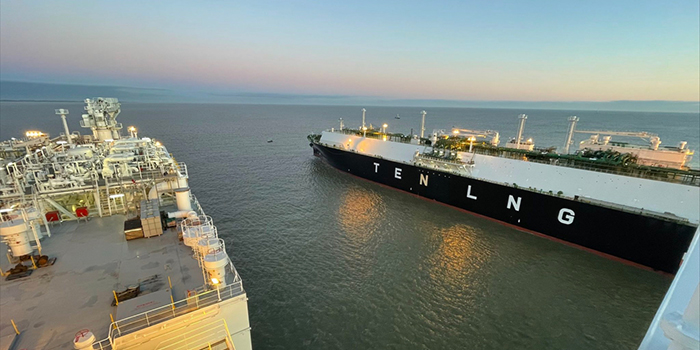
Today, Uniper brought Germany’s first full cargo of liquefied natural gas (LNG) to the new LNG terminal, operated by Uniper, in Wilhelmshaven. The LNG ship Maria Energy, owned by Tsakos Energy Navigation, a major energy mover, was loaded in Calcasieu Pass, USA, at the liquefaction facility of the LNG supplier Venture Global Calcasieu Pass, LLC, on December 19, 2022.

The Maria Energy is fully loaded with approx. 170,000 cubic meters LNG (97,147,000 cubic meters of natural gas) – enough to supply around 50,000 German households with energy for one year.

Niek den Hollander, Uniper CCO says: “The successful delivery of the first full LNG cargo to the Uniper terminal in Wilhelmshaven is a testament to the strong partnership between Uniper, Venture Global, and Tsakos Energy Navigation. The use of LNG as a reliable energy source is crucial for the Security of Supply for Germany and Europe. We are committed to contribute our part by bringing more LNG to the European market and especially Germany via the Wilhelmshaven and Brunsbüttel Regas Terminals.”

“Venture Global is very proud to supply the first full cargo of LNG ever delivered to Germany, and we congratulate Uniper and the German government for their swift action to build the infrastructure needed to make this historic day possible,” says Venture Global CEO Mike Sabel. “As strategic partners, we look forward to providing long-term security of energy supply to our allies through the continued delivery of clean and reliable US LNG.”

The LNG cargo delivered on board of the Maria Energy forms part of the commissioning process at the Wilhelmshaven terminal. Commercial operations of the Wilhelmshaven terminal are expected to start in mid-January 2023.

The Uniper LNG terminal in Wilhelmshaven was opened on December 17, 2022. Via the Floating Storage and Regasification Unit (FSRU) Höegh Esperanza, about five billion cubic meters of natural gas can be landed in Germany per year.

For more information visit www.uniper.energy

Equinor and German energy major RWE to cooperate on energy security and decarbonisation

Equinor and RWE have agreed to work together to develop large-scale value chains for low carbon hydrogen.

The partners aim to replace coal fired power plants with hydrogen-ready gas fired power plants in Germany, and to build production of low carbon and renewable hydrogen in Norway that will be exported through pipeline to Germany.

On the 5th of January, the two companies signed a memorandum of understanding (MoU) to jointly develop large-scale energy value chains, building on the partnership between Norway and Germany and the long-term relationship between Equinor and RWE. The cooperation has these main building blocks:

  • Construction of new gas power plants (CCGTs), contributing to Germany’s phase-out roadmap for coal. Equinor and RWE will jointly own the CCGTs which initially will be fueled with natural gas and then gradually use hydrogen as fuel with the ambition of fully to be run on hydrogen when volumes and technology are available.
  • Building production facilities in Norway to produce low carbon hydrogen from natural gas with CCS. More than 95 percent of the CO2 will be captured and stored safely and permanently under the seabed offshore Norway.
  • Export of hydrogen by pipeline from Norway to Germany.
  • Joint development of offshore wind farms that will enable production of renewable hydrogen as fuel for power and other industrial customers in the future.


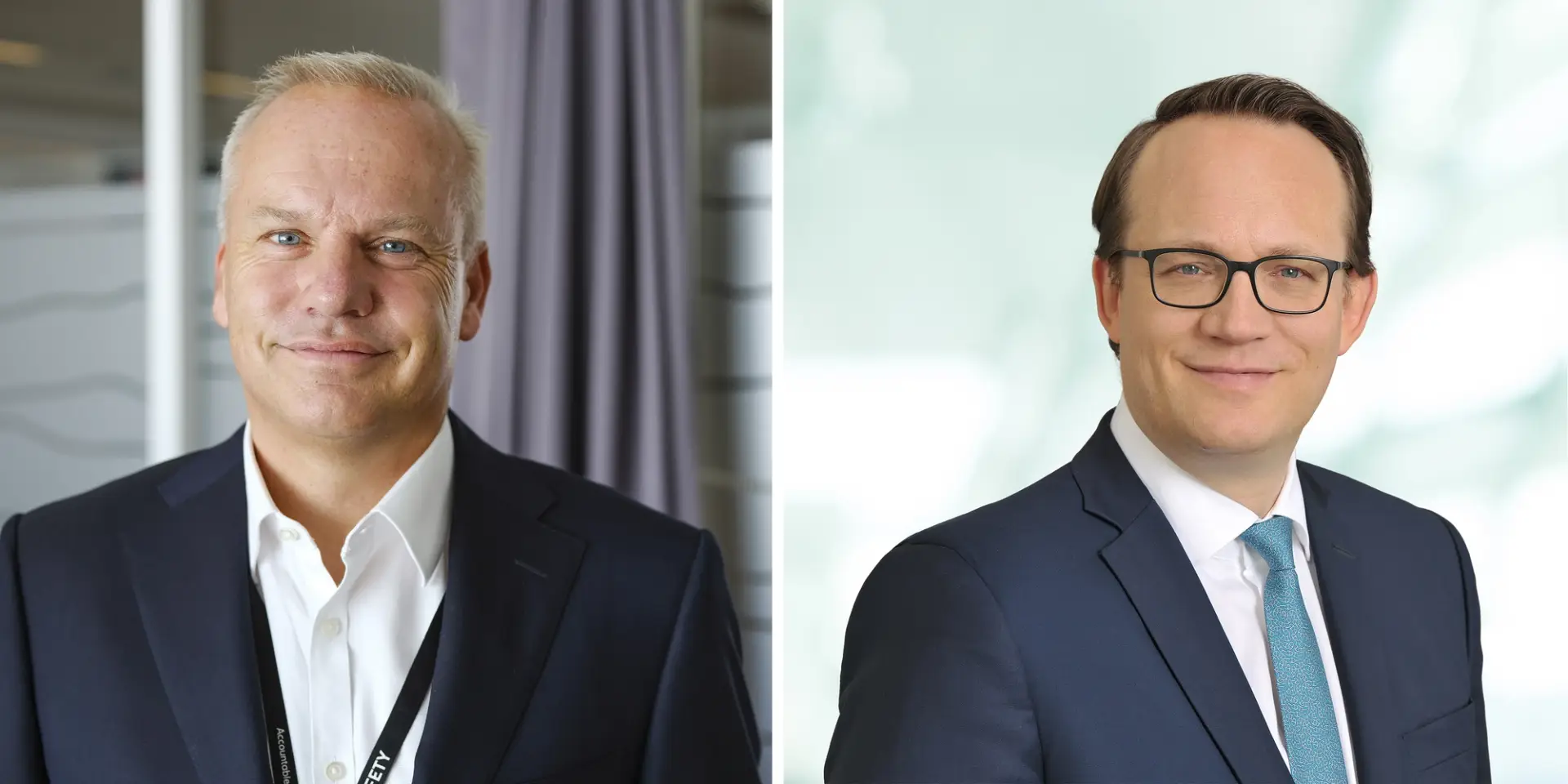
“Through this collaboration we will strengthen the long-term energy security for Europe’s leading industrial country while at the same time offer a viable route to a necessary energy transition for hard to abate industries. The collaboration has the potential to develop Norway into a key supplier of hydrogen to Germany and Europe. This is a unique opportunity to build a hydrogen industry in Norway where hydrogen also can be used as feedstock to domestic industries,” says Anders Opedal, Equinor’s CEO and president.

“In order to make progress in the conversion from fossil fuels to hydrogen, there is an urgent need for a rapid ramp up of the hydrogen economy. Blue hydrogen in large quantities can make a start, with subsequent conversion into green hydrogen supply. This is exactly what we are driving forward with our partnership – providing the industries with relevant quantities of hydrogen. In addition our planned investments into hydrogen-ready gas-fired power plant will ensure security of supply in a decarbonized power sector,” says Dr. Markus Krebber, CEO of RWE.

For more information visit www.equinor.com

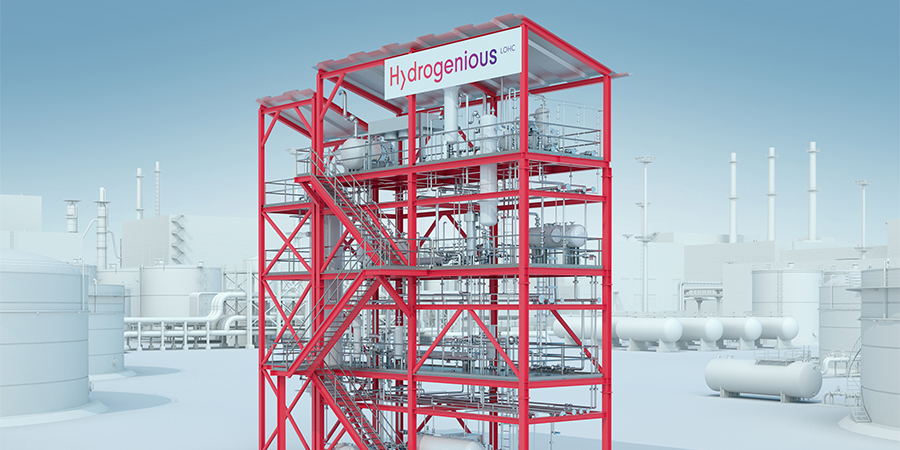
Vopak and Hydrogenious LOHC Technologies jointly take hydrogen logistics to the next level

Vopak and Hydrogenious LOHC Technologies will incorporate an equal shared joint venture, named LOHC Logistix, for hydrogen storage, transport and supply based on Hydrogenious’ Liquid Organic Hydrogen Carrier (LOHC) technology. This is one of the major steps both companies have agreed on recently to push LOHC market solutions and large-scale pilot projects forward.

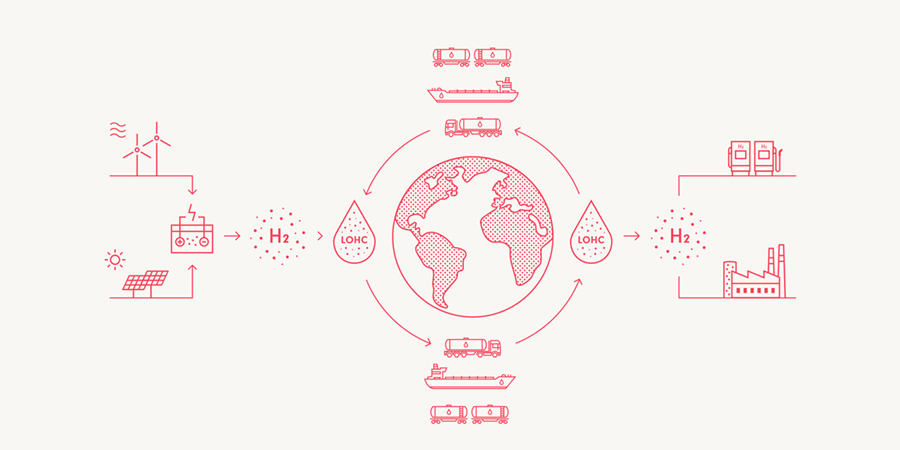
Hydrogen is expected to play a dominant role in future energy systems. When it comes to handling the volatile hydrogen gas, the LOHC technology developed by Hydrogenious has a big potential to help speed up the development of an international hydrogen market. The LOHC pioneer from Germany uses the thermal oil benzyl toluene as liquid organic hydrogen carrier (LOHC-BT), which is already well-established in the industry as a heat transfer medium and has ideal properties for safe handling in ports. Due to its characteristics as a flame retardant and non-explosive carrier with a high volumetric energy density, benzyl toluene can be handled like a fossil liquid fuel within existing infrastructure, tankers and vehicles at ambient pressure and temperature, making it a natural fit with current port infrastructure and fleet of vessels, railcars, and tank trucks. After the release of hydrogen (dehydrogenation), the LOHC can be reused to bind hydrogen many hundreds of times.

Hydrogenious LOHC Technologies has sold pilot-scale LOHC systems to partners in several countries like Finland, Germany and the US over the last years and has implemented the first full LOHC supply chain for hydrogen mobility this summer. Hydrogenious supplies the Hydrogen Refueling Station Erlangen in Germany via LOHC, which is a worldwide novelty.

The joint venture LOHC Logistix GmbH located in Germany will support both parties to facilitate their efforts to supply green hydrogen to off-takers, using LOHC based transportation via ship, train, tanker, etc. The incorporation of the joint venture is subject to customary closing conditions. For transportation and supply, it will purchase hydrogenation as well as dehydrogenation services from/at the respective LOHC plant operating companies and organize transport.

Moreover, the two partners committed themselves to accelerate the establishment of the LOHC storage plant planned at Chempark Dormagen (Germany/North-Rhine Westphalia), for which the kick-off has been given in 2021, as well as a release plant in Rotterdam with a release capacity of 1.5 tonnes of hydrogen per day. The intention of both parties is to accelerate the scale up.

Vopak became involved as a strategic investor in Hydrogenious LOHC Technologies in 2019 (with a shareholding of around 10 percent). Today’s announcement is connected with Hydrogenious‘ as well as Vopak’s first equal investment in the new joint venture and a convertible loan by Vopak to Hydrogenious which can be converted into an equity stake following future funding rounds by Hydrogenious in the upcoming years.

Statements

Dr Daniel Teichmann, founder and CEO at Hydrogenious LOHC Technologies:
“Worldwide there exists a huge capacity of storage tanks, sea vessels, inland tankers and tank trucks for the storage and transportation of liquid fossil fuels. Hydrogenious wants to turn all this valuable infrastructure into the hydrogen infrastructure of the future using our LOHC technology. Ever since Vopak’s investment in our company we have worked very closely together in developing and establishing clean hydrogen value chains. With the build-up of LOHC plants in Chempark Dormagen and Rotterdam we will establish a green hydrogen supply chain that we see as a blueprint for a future even more comprehensive network across Europe and the Middle East and beyond. As a great start into the new year, we are proud to announce this new partnership with Vopak and the foundation of our Joint Venture. As a team we work together to further accelerate the establishment of a clean hydrogen infrastructure in order to ‚carry the new energy world‘, as our corporate claim says.”

Dick Richelle, Chairman Executive Board and CEO Vopak:
“This investment is well in line with Vopak’s strategy to accelerate its portfolio investments towards new energies and sustainable feedstocks. We believe that different types of hydrogen logistics need to be developed to be able to facilitate the needed future flows of hydrogen and hydrogen carriers. We are excited to work together with Hydrogenious to jointly develop the first industrial scale hydrogen supply chain using LOHC.”

For more information visit www.hydrogenious.net

Element 2 and Tower Group partner to bring hydrogen to the South West of England

Element 2, the UK’s leading hydrogen refuelling business, has announced a partnership with Tower Group to provide access to hydrogen for road transport in the South West of England. The partnership connects Tower Group’s locally produced green hydrogen with the infrastructure required to supply fuel to hydrogen-powered trucks and haulage vehicles.

Tower Group is establishing hydrogen hubs in three key locations in Devon and Cornwall as part of plans to establish a new hydrogen ecosystem in the South West. The hydrogen hubs will have the capacity for long-term energy storage and Element 2 will provide end-to-end systems for off-takes of Tower Group-produced hydrogen as part of the agreement.

Element 2 will supply its market-leading mobile refuelling solutions in the regions, as well building permanent refuelling stations to provide hydrogen-powered HGVs with a network of refuelling stations along key haulage routes in Devon and Cornwall. Tower Group’s hydrogen hub plans include sites along critical M5 motorway and A30 trunk roads connecting the South West with London.

Dr Andrew Hagan, chief development officer, Element 2, commented: “Today’s announcement is further evidence of us delivering on our plans to operate a UK-wide network of safe, high-quality hydrogen refuelling stations from Land’s End to John o’ Groats by 2027. By working in partnership with Tower Group and other forward-thinking organisations in the UK hydrogen economy, together we will enable the decarbonisation of heavy goods transport across the country and deliver a greener future. This agreement is a significant step towards this shared goal in the South West of England.”

Alex King, chief executive officer, Tower Group, added: “Hydrogen will play a central role in the decarbonisation of a range of industries in the South West, including road transport. Our hydrogen hubs will have the capacity to store significant volumes of hydrogen, and working with partners like Element 2, we will be able to ensure a regular and reliable supply of hydrogen to customers. Together, we will develop a clean and green eco-system in the South West, supporting local jobs and local industry.”

Simon Earles, chair of Hydrogen South West, said “We are delighted to see partnerships such as these being announced because it is only by working together that we will grow the hydrogen ecosystem to meet the increasing demand in the South West. I am hugely excited to see the hydrogen production, storage, and distribution at the heart of this collaboration come to life and help fuel the region’s transition to net zero.”

Element 2 will also provide Tower Group with technical and logistical support for planning or scoping exercises in relation to establishing its hydrogen refuelling solutions, as well as collaborating with Tower Group to identify fleet customers for the hydrogen stored at its facilities.

For more information visit www.element-2.co.uk

‘Record’ floating production capacity sanctioned in 2022

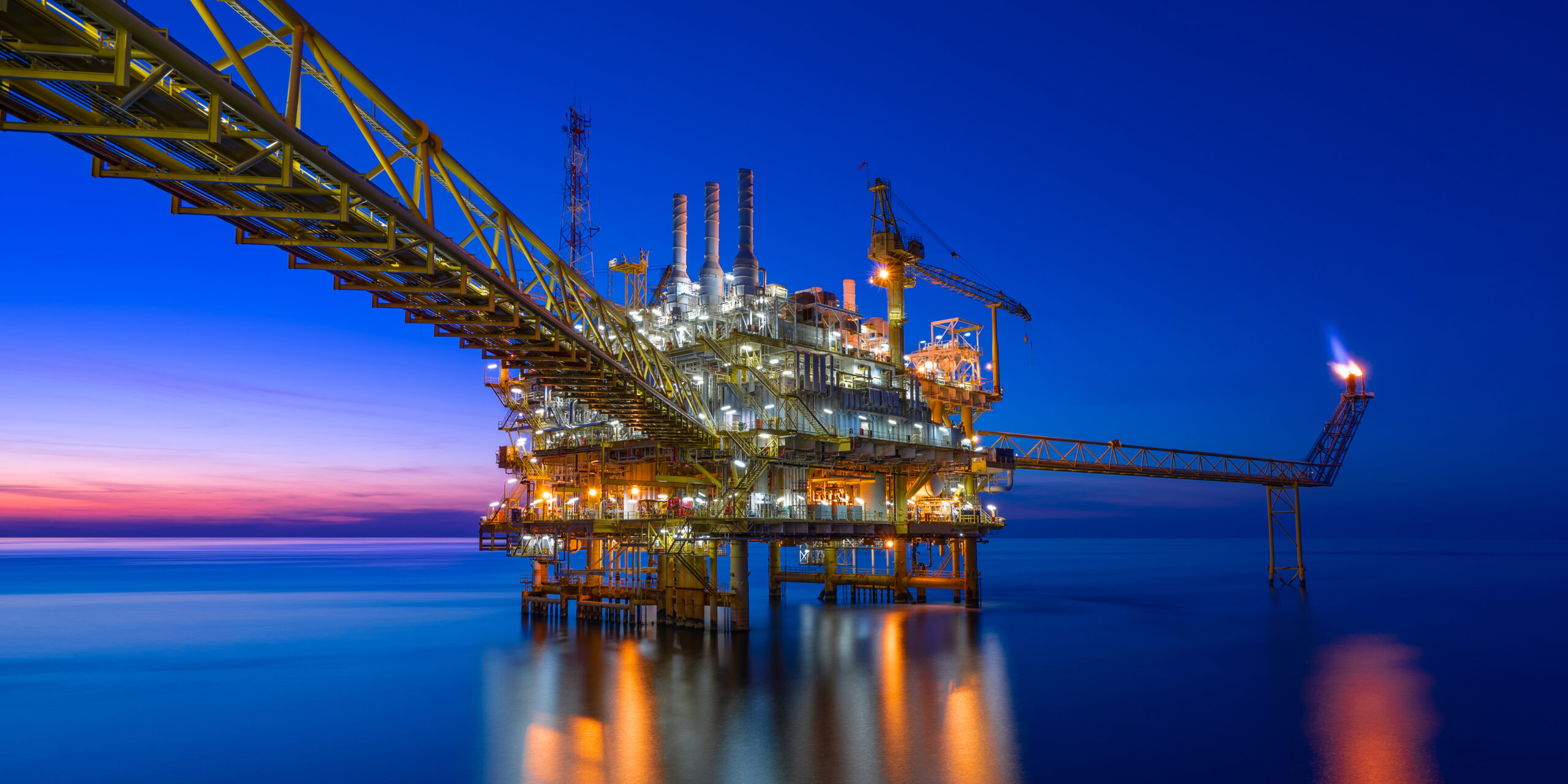
More than 2 million barrels per day of floating production system (FPS) throughput capacity could be sanctioned this year – the highest for more than a decade – according to analysis from Westwood Global Energy.

As the final month of the year ticks on, Westwood reports a total of 1.9 million barrels of oil equivalent per day of FPS throughput capacity has been sanctioned so far – or around 1.3 million bpd of oil and 3.8 billion cubic feet per day of gas.
This represents a 7 percent increase on 2021, with Westwood anticipating an additional 180,000 boepd of FPS capacity to be sanctioned before the end of the year.

With a few remaining projects still set to be sanctioned before year-end – and despite the deferral of several major contracts – 2022 will still represent the highest FPS throughput capacity sanctioned since 2010.

13 FPS units have been approved so far this year, with an estimated engineering, procurement and construction (EPC) value of $15 billion – a 9 percent rise on last year.

Of these, 10 were floating production, storage and offloading (FPSO) units and three were floating production semi-submersible (FPSS) platforms, while no spars nor tension leg platforms (TLPs) were sanctioned this year.

Despite the increase however, rising cost pressures meant several units were deferred.

Westwood had expected 25 projects worth $19 billion to be sanctioned this year, but delays and development concept changes to projects such as Equinor’s Wisting development in Norway, Shell’s Gato do Mato in Brazil, Shell’s Linnorm scheme in Norway and Santos’ Dorado project in Australia prompted a 14 percent downward revision.

Total EPC award value this year is now expected to reach approximately $16.4bn, driven by 15 units (eight newbuilds, two conversions and five upgrades or redeployments). Meanwhile, Westwood says upgrade work on Cenovus Energy’s Sea Rose FPSO unit and an EPC contract for CNOOC’s Deepwater 2 FPSS could still be sanctioned before the end of the year.

FPS market in 2023

Next year the group estimates total 2.2 million boepd pf capacity could be given the go-ahead, representing an EPC award value of $16bn.

Projects are largely centred in Latin America and West Africa, with major awards expected to include Petrobras’ P-81, P-84 and P-85 FPSOs off Brazil, as well as Equinor’s Pao de Acucar unit.

In Guyana, Modec recently signed the front-end engineering and design (FEED) contract for the fifth Stabroek FPSO unit to be deployed on ExxonMobil’s Uaru field, though the award for this capacity relies on governmental approvals of the field development plan and a final investment decision by the operator.

Other FPS units expected to watch in 2023 include Azule Energy’s Agogo and TotalEnergies’ Cameia FPSOs – both in Angola- Eni’s Baleine FPSO in Cote d’Ivoire and Woodside’s Trion FPSS in Mexico.

Supply chain inflation ‘a concern’

Westwood notes that cost deflation, simplification and standardisation have seen the EPC cost of FPSO units fall by an average of $7,950/boepd of throughput capacity – a discount of nearly 40 percent compared with highs of $12,795/boepd seen during the 2013-14 boom period.

Yet increasing volumes of tenders and greater industry activity have seen average 2022 EPC costs rise to $9,310/boepd.

However, it finds that rising costs are causing “significant delays” to major projects and concerns over shipyard capacity persist as both war in Ukraine and the outcome of China’s ‘Zero-Covid’ policy fuel further uncertainties.

Should this inflation continue, delayed projects such as Equinor’s Rosebank project in the North Sea and its Bay Du Nord development in Canada could see further delays, analysts said, alongside projects like Shell’s Bonga SW in Nigeria and TotalEnergies’ Block 58 – all of which may drag on the headline numbers of throughput capacity sanctioned over the period.

For more information visit www.westwoodenergy.com

Cashco promotes Zach Smith

Cashco is happy to announce the promotion of Zach Smith as regional sales manager at Cashco. Zach will operate out of the Cashco headquarters in Ellsworth, Kansas.

Zach began working with Cashco in May of 2018 as a waterjet operator. Shortly after, Zach worked as a CNC Attendant, CNC Machinist, and Production Scheduler before becoming an Inside Sales person in August of 2021. When asked about goals as Regional sales manager, Zach said, “To help our Reps find new business opportunities and to help provide solutions for our customers.” When asked what he is most excited about, Zach said, “The opportunity to represent and serve Cashco and our customers in a new capacity.”

“Zach is eager to learn new things, and he enjoys taking on new challenges,” said Dimity Ankerholz, VP of sales & marketing, when asked what has allowed Zach to quickly advance his career at Cashco. “He is self-motivated, focused, and enjoys the challenge that the RSM position offers,” added Ankerholz. When asked how his past positions will help him in his new role, Ankerhoz said, “Zach has learned how our products are engineered and manufactured. He is also very knowledgable about all materials and parts. This allows him to offer customers exactly what they need, when they need it.”

Please help us congratulate Zach on his promotion!

Zach can be reached at the following

Office Phone: 785-420-1443
Email: zachs@cashco.com

For more information visit www.cashco.com

Getech takes first steps at Inverness hydrogen hub

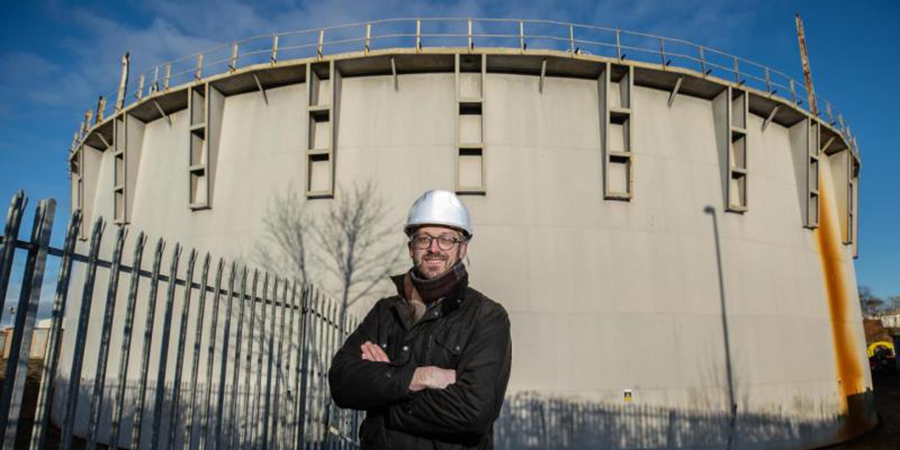
Getech has completed the first phase of development at its Inverness green hydrogen hub, clearing the site ready for new infrastructure.

This first phase of work has seen Getech work with SGN Commercial Services to deconstruct the city’s former gas holder ready for development of the site.

The area on Harbour Road lies between Inverness’s rail depot and industrial area and will offer production, storage and distribution for green hydrogen, as well as supplying the commodity directly to large volume customers, including rail, bus, and heavy goods vehicles (HGVs).

The facility is expected to eventually produce eight tonnes of hydrogen and service up to 800 heavy goods vehicles per day.

Plans are being progressed by Edinburgh-based fuels developer H2 Green – a unit of Getech – alongside a similar a hub at Shoreham Port.

Owing to its location at Inverness’ rail head, the firm says the new facility will be “ideally positioned” to supply clean fuel for a future fleet of hydrogen trains and “kick start the decarbonisation of rail across the Scottish Highlands”.

The scheme will also form the core of Getech’s plans for a “multi-hub green hydrogen network” across the Highlands, with a regional plan to be produced as part of a study announced earlier this year and co-funded by Highland Council.

Meanwhile, Getech has signalled it will look to build further commercial agreements for green hydrogen offtake, linking transport schemes with consumption of by-products of hydrogen generation, including oxygen and zero-emission heat.

Getech CEO Jonathan Copus said “The completion of demolition of the SGN gas holder site demonstrates tangible progress in our hydrogen operations in Inverness and forms part of a range of broader strategic initiatives being undertaken by Getech to achieve the production, storage and supply of green hydrogen – supporting our ambition to establish at least 500MW of new geoenergy and green hydrogen assets by 2030.

Scottish Hydrogen and Fuel Cell Association chief executive, Nigel Holmes, described the scheme “a pioneering example of the hydrogen economy’s potential”

He linked its development to other Scottish projects including the expanding hydrogen bus fleet in Aberdeen and the H100 Fife project in Levenmouth.

“With an abundance of renewable potential across the country, there is a fantastic opportunity to generate even more hydrogen and put Scotland on a clear path to reach net zero by 2045,” he added.

For more information visit www.getech.com

Vertex and Pilkington UK sign major low carbon hydrogen supply agreement

Vertex Hydrogen has signed a ‘Heads of Terms’ off take agreement for low carbon
hydrogen with Merseyside glass manufacturer Pilkington UK.

St Helens’ Pilkington United Kingdom Limited, part of the NSG Group, has led the flat
glass sector in the switch towards low carbon fuels, completing two world-first trials of hydrogen being fired in a glass furnace.

The agreement sets Vertex up to supply Pilkington UK with hydrogen as the manufacturer continues to develop low-carbon ways of manufacturing glass.

The NSG Group recently announced an increased level of ambition to reduce
greenhouse gas (GHG) emissions through a re-certified Science Based Target. It
follows Pilkington UK marking 70 years since Sir Alistair Pilkington invented the float glass process, a pivotal moment which transformed the glass industry.

Pilkington UK glass products provide a wide range of benefits, from thermally efficient Pilkington K Glass S and Pilkington Suncool, which help control internal building temperatures and save energy, to bird-safe Pilkington AviSafe uniquely patterned UV enhanced coating to reduce bird collisions with windows.

Joe Seifert, CEO of Vertex Hydrogen said: “Pilkington has long been admired as
an innovator in the glass industry and led a world first trial of flat glass from hydrogen in 2021 at its famous St Helens facility. The offtake agreement is another iconic name in the northwest manufacturing region switching to Vertex’s low carbon hydrogen.”

Neil Syder, managing director of Pilkington United Kingdom Limited said: “We
are fully committed to our NSG Group target of achieving net-zero by 2050. Firing the
float glass furnace using hydrogen instead of natural gas is a key part of our strategy to reduce carbon emissions. Decarbonising the glass making process represents a significant challenge so it’s critical that we partner with academics and industry groups, particularly here in the Northwest.

Vertex is proud to be helping the UK lead the development of low carbon hydrogen
production as an integral part of HyNet – the UK’s leading industrial decarbonisation
cluster. It will help to solve our urgent need to drastically reduce carbon emissions in our manufacturing sector – securing and growing vital industry.

Vertex is:

  • Delivering an initial 1,000 megawatts of low carbon hydrogen capacity enough to provide the fuel consumed by a city the size of Liverpool;
  • Capturing 1.8 million tonnes of carbon dioxide every year at full capacity –
    equivalent to taking 750,000 cars off the roads;
  • Investing around £1 billion in the North West of the UK and facilitating the
    investment of a further £1 billion or more of associated infrastructure;
  • Playing a leading role in kickstarting the UK low carbon, large scale hydrogen
    market.


For more information visit www.vertexhydrogen.com

Marathon Oil completes Eagle Ford acquisition

Marathon Oil Corporation has announced the completion of its acquisition of the Eagle Ford assets of Ensign Natural Resources for a total cash consideration of $3.0 billion after taking into account closing adjustments. The acquisition was previously announced on November 2, 2022.

“We are pleased to announce the close of our acquisition of Ensign’s high-quality assets in the core of the Eagle Ford Shale,” said chairman, president, and CEO Lee Tillman. “This acquisition satisfies every element of our disciplined acquisition criteria. It’s immediately accretive to our key financial metrics, it will drive higher shareholder distributions consistent with our operating cash flow driven Return of Capital framework, it’s accretive to our inventory life with attractive locations that immediately compete for capital, and it offers truly compelling industrial logic given our existing Eagle Ford footprint and our track record of execution excellence in the play.”

The assets acquired from Ensign Natural Resources (99 percent operated, 97 percent working interest) span Live Oak, Bee, Karnes, and Dewitt Counties across the condensate, wet gas, and dry gas phase windows of the Eagle Ford. Marathon Oil believes it can deliver maintenance level production from the acquired asset of 67,000 net boepd (22,000 net bopd of oil) with approximately 1 rig and 35 to 40 wells to sales per year. The Company’s valuation of the asset was based off this maintenance level programme and does not include any synergy credits or upside redevelopment opportunity. Acquired tangible assets are eligible for full expensing for the purpose of income tax optimisation, including potential deferral of AMT.

For more information visit www.marathonoil.com

Dudick introduces Steri-Flor™ UV

Dudick is pleased to announce the launch of Steri-Flor UV. Steri-Flor UV is a multi-functional epoxy floor coating with increased UV stability compared to conventional epoxies. It provides good resistance to common chemicals and daily traffic and may be used as a base/colour coat, receiving coat, or grout coat for decorative broadcast floors.

“We saw the need to create a product that can meet the everyday demands of our flooring contractor and have good raw material availability, all while being very cost competitive. Steri-Flor UV completes the Steri Series product line up due to its increased UV stability,” said Anthony Allegra, Carboline, global product line manager.

The decorative aspect of Steri-Flor UV makes it great for public spaces like retail spaces, automotive dealerships, and veterinary clinics and workshops. Its chemical resistance means it also performs well in clean rooms and laboratories.

“The versatility of Steri-Flor UV is very exciting. It’s an ideal product for distributors and contractors since it is crystal clear but will take pigment packs. Steri-Flor UV can replace the need for warehousing multiple products to build out everyday epoxy flooring systems,” said David Dudick, Dudick, vice president.

Steri-Flor UV has great flow and levelling with more UV inhibitors than most economical 100 percent solids epoxies. When paired with our easy-to-use colour packs in the field, this product allows contractors to stock one versatile product for any number of projects.

For more information visit www.carboline.com

Alleima receives breakthrough order of OCTG tubes for carbon capture and storage project

Alleima has received an order of Oil Country Tubular Goods (OCTG) tubes to be used for a carbon capture and storage (CCS) project. Through this breakthrough order, Alleima enters a new market, which is an important milestone to drive profitable growth by capitalising on the green transition.

Carbon capture and storage (CCS) is the process of capturing CO2 from heavy industry and energy plants, transporting it, and storing it in underground geological formations. The aim is to prevent the release of CO2 and minimise the effects of climate change. The number of CCS fields in operation are currently limited but project announcements are increasing rapidly, as countries, and energy companies in particular, aim to meet 2050 net-zero target.

“We are excited to have taken this order and we believe that the market for the technology of carbon capture and storage will continue to grow. This is one example of how our advanced materials and products enable new technologies that contribute to the green transition”, says Michael Andersson, president of Tube division.

The order that was received in the fourth quarter of 2022 relates to OCTG tubes in the material SAF 2507, which will be used to control the pressure and keep the CO2 in place. It is valued at about SEK 40 million, with deliveries scheduled for the first half of 2023.

“Similar products that our customers today use for oil and gas extraction, will now be used for carbon capture solutions. We are looking forward to the coming developments”, says Nigel Haworth, president of Business Unit Energy.

For more information visit www.alleima.com/en

CMS awarded fuels projects in South Korea and Spain

CMS Corporation’s (CMS) worldwide fuels program continues to expand – the Maumee, OH based firm announced today it has been awarded fuels projects at Kunsan Air Base, Republic of Korea, and Moron Air Base in Spain.

The $2M project at Kunsan Air Base and $1.5M project at Moron Air Base were both awarded under the Air Force $2.6 billion Worldwide Engineering and Construction (WE&C) IDIQ contract.

Under the $2M task order at Kunsan Air Base, CMS will inspect, repair, and bring Tanks 10, 17 and 18 into compliance with API 653 or STI SP001. Tank 10 is a 60,000-BBL cut & cover JP-8 tank (28’ H x 126’ D).

Work will include repairs to diffusers, gauges, turbine vertical pump, receipt lines, internal vertical ladder, product recovery tank piping, gauge hatch, tank data plate, etc. We will also recoat the tank interior using a 3-coat system, with special attention to noted areas of coating failure.

Tanks 17 and 18 are each 50,000-BBL JP-8 below-grade vault horizontal cylinder tanks (10’6” D x 78’ L). Each tank will require the same repairs, including grounding/bonding, installation of a vapor detection systems and leak detection alarm systems, and repairs to mechanical tape gauges, interior access ladders, receipt piping, vault penetration pipe sleeves, tank level gauges, water draw-off systems, water probes, vertical turbine pumps, tank data plates, etc. We will also recoat the shell, heads and nozzles on each tank (approx. 3,000 SF for each tank).

At Moron Air Base, CMS will inspect and modernize tanks and oil water separators (OWSs). CMS will clean and inspect 19 tanks ranging in size from 31.5 BBL to 38 BBL. The tanks contain either JP-8 jet fuel, diesel fuel, or MOGAS. The four largest tanks will receive an API 653 modified inspection and the remaining tanks will undergo STI inspection.

Additionally, CMS will clean, inspect, and test seven OWSs, including the related spill containment areas, and perform pipeline inspections and repairs on 4,400 meters of fuel piping.

“We are pleased with the continued expansion of our worldwide fuels program,” stated CMS Chairman and CEO, Ernest Enrique, PE. “CMS is equipped with the seasoned fuels personnel and efficient processes necessary to make each of these projects a success. We look forward to timely completion of these projects.”

For more information visit www.cmscorp.com