

Effective monitoring of critical infrastructure is essential across the power generation, oil, gas, and petrochemical industries, where smooth operation is crucial in today’s competitive and cost-sensitive energy landscape. Condition monitoring specialist Sensonics has established itself as a leader in developing effective monitoring systems, drawing on over 50 years of experience, particularly in vibration monitoring products. A notable example of their expertise is a recent cooling tower monitoring project at a major petrochemicals plant.
The project engineer at the facility indicated the need for a reliable system to monitor and protect cooling tower fans, specifically to prevent failures related to the fan blades. The requirement involved individual monitoring systems for each of the twenty motor and gearbox-driven fans located around the cooling tower’s base.
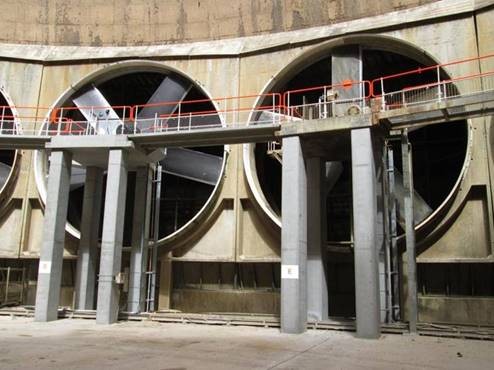
The project engineer detailed the application requirements, stating, “The fan speed is 131 RPM / 2.18 Hz, and we want to mount a single transducer on the gearbox (each fan is mounted on the gearbox output shaft) to address the potential failure of the fan blades. Previous failures resulted in severe vibrations that damaged the concrete platform supporting the fan assembly and affected adjacent fans due to flying debris.” Additionally, it was noted that the fans operate in a very wet and windy environment, drawing moist air out of the cooling tower packing and blowing it across the gearbox and motor.
Based on these specific challenges, it was determined that a suitably ranged 4-20 mA vibration transducer should be installed and connected to a nearby unit equipped with start/stop buttons for the fans, enabling quick shutdown in the event of excessive vibration. Furthermore, overall vibration levels needed to be relayed to the main plant Distributed Control System. The application required that the transducers respond to frequencies below 2 Hz, eliminating the need for local displays or additional diagnostics. The objective was to create a straightforward system capable of reliably tripping the fan in case of a malfunction while providing overall vibration level information to the DCS.
Upon confirming the specific requirements for this vibration monitoring application, Sensonics proposed a solution that included their DN26 G3 dual-channel protection system and VEL/GLF low-frequency velocity transducers. Well-established in the condition monitoring market, Sensonics has delivered thousands of compact and innovative DIN rail-mountable DN26 G3 dual-channel vibration monitors, providing reliable and cost-effective monitoring across various installations. This fully programmable signal conditioning unit can monitor two channels of absolute vibration, shaft vibration, or shaft position, with an additional channel option for measuring speed or serving as a phase reference.
To complete the solution, the VEL/GLF low-frequency velocity transducer turned out to be well-suited for the large fans operating at low RPM. This electrodynamic sensor offers superior performance compared to piezoelectric devices by combining high sensitivity with a frequency response down to 0.5 Hz. Its sensitivity and excellent noise performance provide the dynamic range necessary for detailed gearbox vibration analysis, making it ideal for measuring velocity vibration on equipment operating at speeds as low as 30 RPM. The VEL/GLF also presents advantages over traditional piezoelectric sensors, which can be prone to various interferences that result in false readings and alarms in low-frequency applications.
Thanks to its robust design, the VEL/GLF boasts high noise immunity, attributed to the low impedance electrodynamic nature of the sensor assembly. Additionally, the sensor design effectively filters high-frequency events and eliminates the need for electronic integration, rendering it immune to saturation issues that can affect the reliability of other piezoelectric devices.
For more information visit www.sensonics.co.uk