
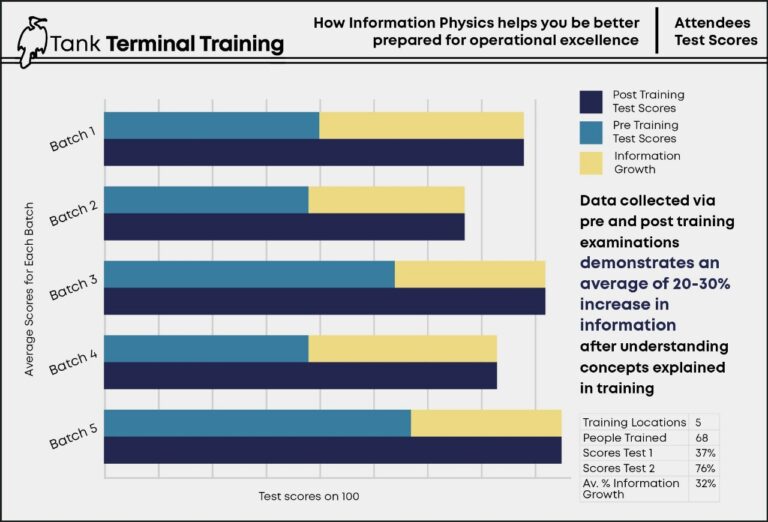
After training over a thousand individuals across various levels of the marine storage terminal industry, it has been observed that many professionals are unaware that they may be operating incorrectly while appearing to do things right. This was tested by inquiring whether participants had ever read the International Safety Guide for Oil Tankers and Terminals (ISGOTT) or the Society of International Gas Tankers and Terminals (SIGTTO) guide.
Despite smooth operations and a low number of accidents, a concerning dependency on others to perform correctly was evident. For example, one loading master was found to be unaware of the difference between ‘port’ and ‘starboard,’ yet he was responsible for the cargo loading/discharge agreement and the Ship/Shore Safety Checklist. This individual had not received formal training but rather learned through experience from a predecessor who had also not consulted the ISGOTT and SIGTTO guidelines.
Onboard, this loading master feigned understanding of the relevant questions and terminology, completing checklists without inquiry and ensuring documentation was signed and stamped. He did not request to inspect the deck, engine room, or pump room, as he had not been instructed to do so, thus relying solely on the chief officer’s knowledge.
ISGOTT encompasses 25 chapters of quantifiable information, which is essential for all safety and natural systems. A significant perception issue exists: individuals often do not recognise the importance of optimising the information and knowledge available to them unless directed to do so.
When asked, most terminal managers admitted to not having read the international guidelines or adapted their policies accordingly. TankTerminalTraining conducted a global assessment of this information deficit and discovered that only a handful had made the necessary efforts.
It is critical for terminal managers, operators, and supervisors to understand that only systems utilising optimal information function effectively. When an information deficit is identified, performance suffers, leading to inefficiencies that can be characterised as uncertainty. In physics, these uncertainties are referred to as entropy, or disorder resulting from information deficiency. Entropy can be understood in various contexts:
– Physical Entropy: Refers to information as energy that is unavailable for productive work, rendering optimal functionality impossible.
– Information Entropy: Involves a lack of information necessary to comprehend messages, leading to misunderstandings and communication breakdowns. This form of entropy encompasses both the information that is absent and that which is intentionally suppressed.
– Social Entropy: Similar to physical entropy, this concept describes information as energy that cannot be utilised effectively, resulting in societal inefficiencies and uncertainty.
TankTerminalTraining provides courses aimed at helping operators enhance their performance.
For more information visit www.tankterminaltraining.com