

The MultiPLHY demonstration project has achieved a significant milestone with the successful startup of the world’s largest multi-megawatt high-temperature electrolyser in an industrial environment at Neste’s renewable products refinery in Rotterdam, the Netherlands. The pioneering installation demonstrates the viability of renewable hydrogen production for reducing fossil hydrogen consumption in the refining industry.
Project Objectives and Emissions Reduction
The pilot project addresses a critical challenge in refinery decarbonisation: replacing hydrogen produced from fossil raw materials with renewable hydrogen. This substitution represents one of the primary pathways for lowering greenhouse gas emissions in refining operations. Following successful startup, the demonstration project will proceed to a comprehensive test programme validating the technology’s performance characteristics under industrial operating conditions.
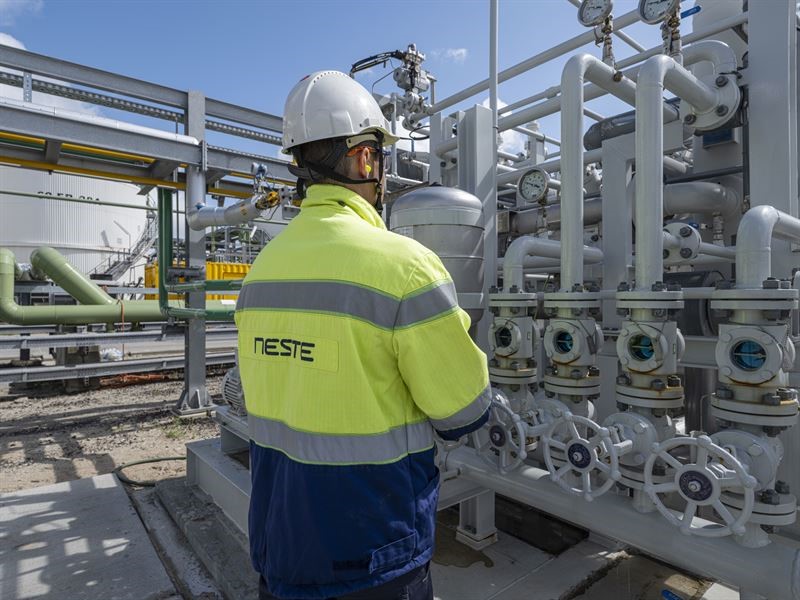 Photo: The MultiPLHY pilot installation at Neste’s refinery in Rotterdam, the Netherlands
Consortium Structure and Responsibilities
MultiPLHY operates as a collaborative demonstration project with consortium partners Neste, Sunfire, CEA, and ENGIE, each contributing specialised expertise. German electrolyser manufacturer Sunfire provided the high-temperature electrolyser, whilst SMS group supplied the hydrogen processing unit. Neste holds responsibility for refinery integration and, together with Sunfire, oversees unit operation. The research and technology organisation CEA coordinates overall project activities, whilst ENGIE manages techno-economic assessment.
Jukka Kanerva, senior vice president of renewable refining at Neste, emphasised that the MultiPLHY project has provided valuable insights and experience in integrating industrial-scale renewable hydrogen production into refinery operations. He affirmed Neste’s commitment to exploring various pathways for replacing fossil-based hydrogen in refining processes to reduce greenhouse gas emissions from the company’s own operations. Kanerva highlighted that the demonstration project illustrates the importance of cooperation across the entire value chain.
Technology Specifications and Efficiency
The electrolyser integrated into Neste’s refinery processes utilises Solid Oxide Electrolysis Cell technology developed by Sunfire. The 2.6-megawatt high-temperature electrolyser comprises twelve electrolysis modules operating at temperatures of 850 degrees Celsius, producing more than 60 kilograms of renewable hydrogen per hour.
The high-temperature operating regime delivers significant efficiency advantages. Through utilisation of waste heat, the electrolyser requires substantially less electricity to produce renewable hydrogen compared to alternative market solutions. This efficiency benefit proves particularly valuable in industrial environments where waste heat streams are available for integration.
Nils Aldag, CEO of Sunfire, underscored that the company’s high-temperature SOEC electrolysers will serve as the preferred solution in numerous applications where waste heat availability exists, owing to their superior efficiency. He characterised the MultiPLHY project as demonstrating that the innovative technology can be integrated into industrial environments at a large scale, describing the milestone as a source of pride for the organisation.
Industrial Integration and Scale Achievement
The installation represents the largest high-temperature electrolyser deployment in an industrial environment globally, marking significant progress for both the technology and the clean hydrogen sector. The achievement demonstrates that advanced electrolyser technologies developed at smaller scales can be successfully scaled and integrated into complex industrial operations with multiple interfacing systems and operational requirements.
Pierre Olivier, head of Hydrogen Lab at ENGIE, noted that high-temperature electrolysis possesses the potential to make renewable hydrogen more affordable whilst increasing the energy efficiency of various industrial processes globally. He characterised the construction and commissioning achieved by Sunfire and Neste as a tremendous accomplishment and significant step toward making green hydrogen competitive with conventional production methods.
Sector Significance and European Industrial Development
Mirela Atanasiu, head of unit operations and communication at the Clean Hydrogen Partnership, expressed enthusiasm regarding the successful operation of the high-temperature electrolyser at Neste’s Rotterdam refinery. She emphasised that this installation, as the largest of its kind in an industrial environment, represents a significant milestone for both the technology and the clean hydrogen sector. Atanasiu congratulated all project partners for realising the project and advancing the European electrolyser industry as a whole.
Refining Industry Decarbonisation Context
Hydrogen serves essential functions in petroleum refining, including hydrocracking, hydrotreating, and desulfurization processes that convert crude oil into refined products meeting specifications. Conventional refineries typically produce hydrogen through steam methane reforming of natural gas, a carbon-intensive process that constitutes a substantial portion of refinery greenhouse gas emissions.
Transitioning to renewable hydrogen produced via electrolysis powered by renewable electricity offers a pathway to reduce refining emissions without fundamentally altering process configurations. However, the economics of renewable hydrogen have historically presented challenges due to higher production costs compared to fossil-based hydrogen. High-temperature electrolysis technology addresses this economic barrier through superior electrical efficiency, particularly when integrated with waste heat sources abundant in refining environments.
Technology Validation and Commercial Pathways
The test programme following startup will generate operational data validating performance characteristics, including hydrogen production rates, electrical efficiency, thermal integration effectiveness, operational reliability, and maintenance requirements. This performance data proves essential for evaluating commercial viability and informing potential larger-scale deployments.
Successful demonstration at multi-megawatt scale in an operating refinery provides evidence that high-temperature electrolysis can meet the demanding requirements of industrial applications, including continuous operation, integration with existing infrastructure, and compliance with safety and regulatory standards governing hydrogen production and handling.
Value Chain Collaboration Model
The MultiPLHY consortium structure exemplifies collaborative approaches to advancing emerging energy technologies, combining technology developers, industrial operators, research institutions, and energy companies. This model enables risk sharing, combines complementary expertise, and accelerates technology validation through access to industrial-scale demonstration facilities.
The project benefits from European support through organisations including the Clean Hydrogen Partnership, reflecting policy priorities for developing hydrogen value chains as part of broader energy transition and industrial decarbonisation strategies. Demonstration projects at a commercially relevant scale provide crucial validation, bridging laboratory development and full commercial deployment.
The successful startup at Neste’s Rotterdam refinery establishes high-temperature electrolysis as a viable technology pathway for industrial renewable hydrogen production, particularly in applications where waste heat integration enhances economic competitiveness. The project’s progression to performance validation testing will provide data supporting wider adoption decisions across refining and other industrial sectors seeking to reduce fossil hydrogen consumption.
For more information visit www.neste.com