


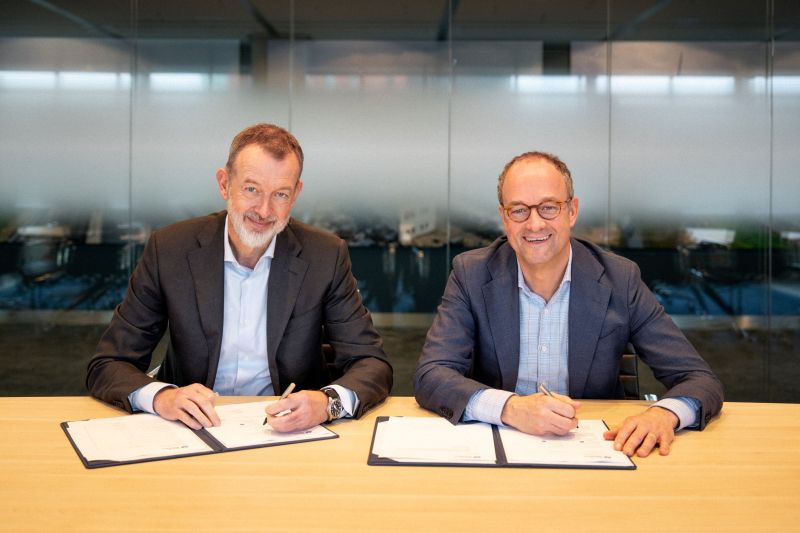
Evos has begun work on a major expansion project at its Rotterdam terminal focused on the storage of (low-carbon) methanol and ethanol. The development was formally launched during a signing ceremony at the Port of Rotterdam, attended by Evos CEO Daan Vos and Port of Rotterdam Authority CEO Boudewijn Siemons, marking a significant milestone in the companies’ collaboration.
The project will involve the construction of five new storage tanks with a combined gross capacity of 67,500 cubic metres, alongside a new pump station. In addition, a new jetty will be built by the Port of Rotterdam Authority. The expansion will allow Evos Rotterdam to increase its handling capacity for methanol and ethanol, supporting both established industrial markets and rising demand for cleaner marine fuels used in bunkering.
Demand for methanol in traditional chemical markets remains strong, with formaldehyde continuing to account for the largest share of European consumption. At the same time, Europe is moving towards low-carbon methanol, with bio- and e-methanol expected to capture an increasing market share. Demand for low-carbon methanol as a marine fuel is anticipated to rise in the early 2030s as regulatory measures take effect. Meanwhile, Europe’s decarbonisation targets are also expected to drive higher ethanol imports, supported by increased use of renewable ethanol in road fuels and the expansion of sustainable aviation fuel production from alcohol-based feedstocks.
According to Vos, the investment strengthens the strategic role of Evos’ Rotterdam terminal as a key hub for methanol and ethanol while preparing the facility for the future scale-up of low-carbon marine fuels. He added that the company’s long-term “transition partnerships” strategy focuses on collaborative progress, and that working closely with the Port of Rotterdam positions both parties to support customers in industry and shipping as the energy transition accelerates.
Siemons said the expansion represents an important step toward improving the sustainability of the port. By investing in a new jetty and quay wall, the Port of Rotterdam Authority is creating the infrastructure required for the safe and efficient handling of cleaner fuels such as methanol. He noted that the collaboration with Evos reinforces a shared commitment to supporting the energy transition while helping ensure the port remains resilient and aligned with its goal of achieving climate neutrality by 2050.
The project is expected to become operational in early 2028.
For more information visit www.evos.eu