


Let’s start with some data because, well, safety without stats is like a tanker without brakes -pointless and dangerous.
According to the Health and Safety Executive’s 2023/24 statistics, workers in the UK face a 1 in 200,000 chance of being killed at work. Narrow that down to England, and the odds improve slightly to 1 in 260,000. Why the difference? We’re not going down that rabbit hole today.
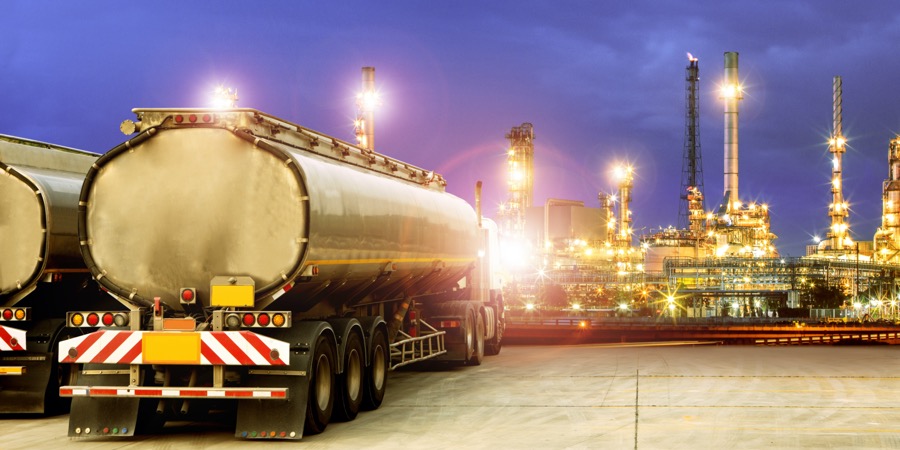
Naturally, these odds depend on what you do and, surprisingly, how many birthday candles you’ve blown out. Workers over 65 accounted for 30 of the 138 workplace deaths last year. Shocking? Yes. At that age, most of us prefer reclining chairs over risky endeavours – but apparently, some seniors still like to live life on the edge (literally).
Among the 16 causes of workplace fatalities (yes, there’s even an “Other” category – 5 deaths, in case you’re curious), the big villain is falls from height. This accounted for 50 of the 138 deaths, or 36 percent. To put it bluntly, gravity is winning.
Now, let’s talk height. A fall from just 1 metre can ruin your day – and maybe your life. But in the world of bulk fluid transfer on tanker tops, we’re not dealing with 1-metre falls. We’re talking heights of 3.6 to 4.2 metres (that’s 13’-9” for the imperial-minded), where a worker has just under a second to reflect on their life choices before hitting the ground at 32.6 km/h (20.28 mph). Cheery, right?
And it’s not just the height. Let’s not forget the workers themselves – average height, 1.65 to 1.93 metres, weighing 75 to 110 kg. A gap of more than 30 cm (12”) in their work environment becomes a perfect fall-through point. That’s not a design feature; that’s a safety nightmare.
Now, before we dive into solutions, let’s take a quick break for some visual reality. Here’s a picture that shows exactly what NOT to do when working on tanker tops.
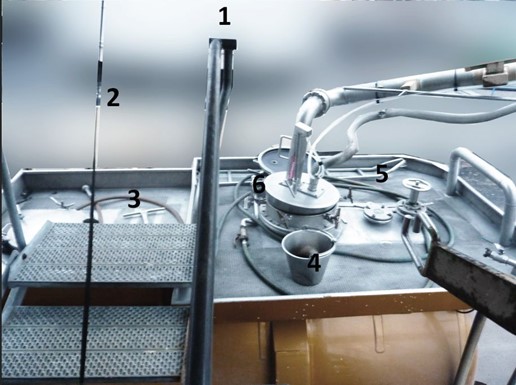
The Scene of the Crime: 6 Major Safety Concerns
- The Folding “Safety” Stairs
These stairs have seen better days. They’ve been dragged, bent, and generally mistreated, leading to misaligned bearings and an eventual catastrophic failure waiting to happen. Oh, and that last step? It’s a 35 cm leap of faith to the tanker top. Not cool. - The Lifeline
Sure, the lifeline stops a fall, but that’s the bare minimum. What happens if the worker is knocked unconscious? Hanging in a harness isn’t just uncomfortable – it’s dangerous. (Look up “Orthostatic Suspension” for a chilling read.) - Tanker Top Hazards
Picture this: A worker stepping down onto a manhole cover, loose hose, and a T-bar wrench. It’s like an obstacle course designed by someone with a grudge. - The Drip Bucket
This drip bucket might be functional, but it’s hogging precious space in an already cramped area. - Trip Traps
A random ladder and a coil of hose are just begging to trip someone. Why are they even there? - The Loading Arm
The arm design and positioning are off. Inserted at an angle into the manhole, it creates gaps, making vapour return ineffective. Worse, the tanker is parked too close to the platform, thanks to limited arm reach.
The Big Question: How Do You Fix This?
Preventing falls from tanker tops isn’t just about adding safety cages or harnesses – it’s about rethinking the entire operation:
- Why does the worker need to be on the tanker top? Can the process be redesigned to avoid it?
- How can you eliminate trip hazards, reduce manual effort, and improve ergonomics?
- Is your equipment designed to prioritise safety while being practical to use?
At Carbis Loadtec, we’ve spent decades answering these questions with real solutions. Our motto, YOUR SAFETY, OUR MISSION, isn’t just a tagline – it’s the foundation of everything we do.
Unlike some suppliers who slap on the cheapest “solution” and call it a day, we go deeper. From assessing gaps in safety cages to ensuring loading arms are positioned for maximum safety and efficiency, we leave no stone unturned.
Take the Safe Route
Falls from tanker tops aren’t just statistics – they’re real risks with real consequences. If you’re responsible for tanker-top operations, don’t settle for quick fixes that create bigger problems.
Call us for a professional assessment. We’ll help you design the safest, smartest solution for your workers – because gravity doesn’t take a day off, and neither should safety.
*Source: Health and Safety Executive, published 3rd July 2024.
For more information visit www.carbisloadtec.com