
As the global demand for sustainable fuels accelerates, one critical bottleneck continues to hold the industry back: access to sufficient volumes of high-quality renewable feedstocks. Without reliable, clean input materials, even the most advanced biofuel technologies cannot scale effectively.
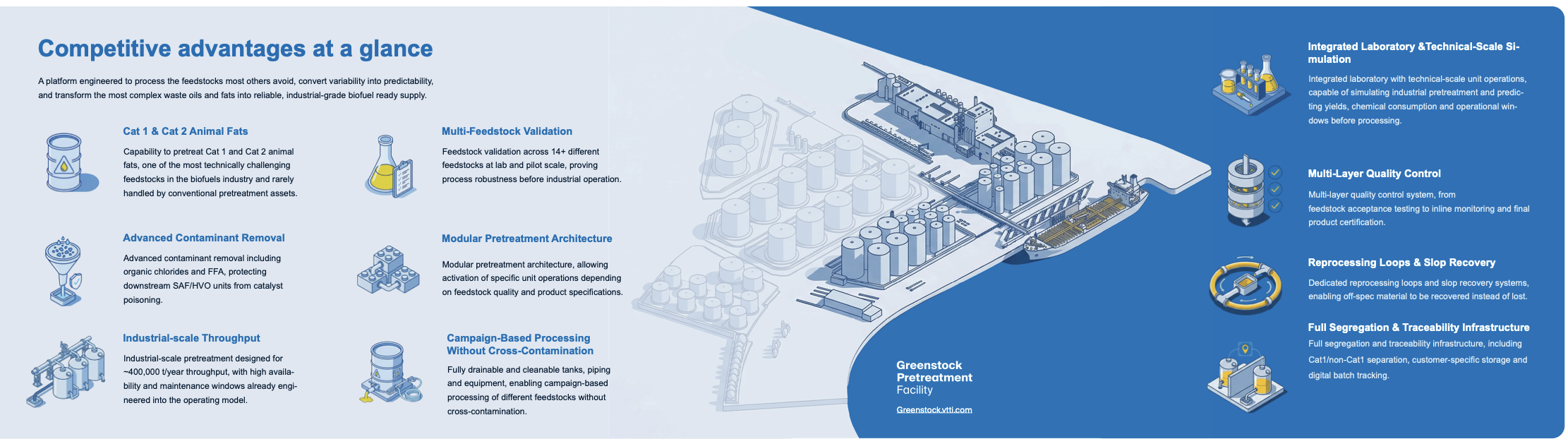
This is exactly where Greenstock Pretreatment Facility (GPF) in Amsterdam comes in. Developed by VTTI and Connex, GPF is a waste treatment plant that plays a strategic role in unlocking the renewable energy value chain. By enabling the pretreatment of waste and residues into high-quality feedstock for Sustainable Aviation Fuel (SAF) and Renewable Diesel (HVO), GPF supports the production of these low-carbon fuels, which deliver up to 80–90 percent lifecycle CO₂ emissions savings compared to conventional fossil fuels. In doing so, SAF and HVO not only drive the decarbonization of transport and aviation but also contribute to cleaner air, fostering a healthier environment and a positive impact on public health.
Understanding the role of GPF
To grasp the importance of Greenstock Pretreatment Facility, it’s essential to first clarify what it is.
- A municipal waste treatment plant.
- A waste disposal facility.
- A producer of biofuels or renewable fuels.
GPF is:
- A state-of-the-art pretreatment facility that cleans and upgrades waste and residue streams of lipidic (oils and fats) origin to make them ready for its further conversion into SAF and HVO.
- A critical infrastructure link between waste collection and renewable fuel production.
- A solution that ensures feedstocks meet the strict quality standards required by biofuel producers.
In simple terms, GPF takes raw, often contaminated waste streams and transforms them into high-quality inputs ready for conversion into clean energy.
Bridging the gap in the value chain
Renewable fuel production depends heavily on the quality of feedstocks such as used cooking oil (UCO), animal fats, and other waste and residues. However, these materials are rarely ready for direct use. They often contain solid impurities, water, and other contaminants, making them unsuitable for processing.
Without proper pretreatment, valuable resources are underutilised or even lost.
GPF solves this problem by serving as a bridge between waste collection and biofuel production, ensuring that what was once considered waste becomes a viable, high-quality resource, giving to them a second life and avoiding them to end up in nature with it consequential environmental impact
Circular economy in action
At its core, GPF is a powerful example of the circular economy in action. Take used cooking oil (UCO) as an example:

What was once a waste is now part of a continuous value loop – reused, refined, and repurposed into clean energy. This is not just recycling. This is value creation.
Supply chain impact
The transition to a lower-carbon future requires more than innovation in fuel production. It demands robust infrastructure and smarter use of existing resources. Greenstock Pretreatment Facility unlocks the hidden potential of waste and residues, converting them into valuable building blocks for clean energy.
By closing the gap between waste and fuel, GPF plays a crucial role in:
- Advancing circular economy principles.
- Strengthening supply chains for renewable fuels.
- Accelerating the global shift toward sustainability.
A smarter way forward
In a world where sustainability is no longer optional, facilities like GPF offer a smarter, more efficient way forward. They show that the solution isn’t just about producing cleaner energy but about rethinking the entire system behind it.
Because when waste becomes value, the circular economy becomes reality.
For more information visit www.greenstock.vtti.com