

Valkim Technologies LLC and Valkim Technologies BV have released a new white paper urging multinational asset owners to move beyond traditional geometry-based inspection methods and adopt a more outcome-oriented approach to emissions compliance for floating roof storage tanks.
The paper, titled From Proxy Geometry to Emissions Performance, is directed at operators managing assets under both US and European regulatory frameworks. It argues that while periodic seal gap inspections remain a valid compliance tool, they were designed for an era when direct emissions measurement was impractical, and that advances in field instrumentation now make it possible to add a meaningful performance verification layer alongside existing requirements.
The Drill Bit vs. The Hole
Central to the white paper’s argument is a distinction between proxy compliance and outcome verification. As the authors put it, regulators and communities do not need a more mechanised seal-gap ritual — they need confidence that emissions are actually being reduced. Seal gap measurement is described as “the drill bit,” while quantitative emissions verification represents “the hole”: direct, trendable evidence aligned to the environmental purpose of the regulation.
The paper does not propose replacing any mandatory US inspection requirements. Instead, it outlines a structured path for operators to add a performance layer that strengthens regulatory narratives, improves maintenance prioritisation, and reduces unnecessary worker exposure on tank roofs.
Bridging Two Regulatory Cultures
A key focus of the white paper is the divergence between US and European compliance philosophies. In the United States, tank compliance has historically centred on prescribed geometric criteria, observable, auditable, and enforceable. In Europe, under the Industrial Emissions Directive (IED) and Best Available Techniques (BAT) frameworks, the primary evidentiary question is whether emissions are demonstrably minimised under actual operating conditions.
Valkim Technologies notes that neither approach is inherently superior — they represent different evidentiary hierarchies shaped by regulatory history and enforcement capability. For multinational operators, however, managing two distinct compliance cultures creates internal fragmentation and limits the quality of environmental governance reporting.
The recommended solution is a single global performance doctrine: maintain prescriptive inspections where required by local rules, and standardise a quantitative verification layer deployable across the entire asset portfolio.
What the Performance Layer Looks Like
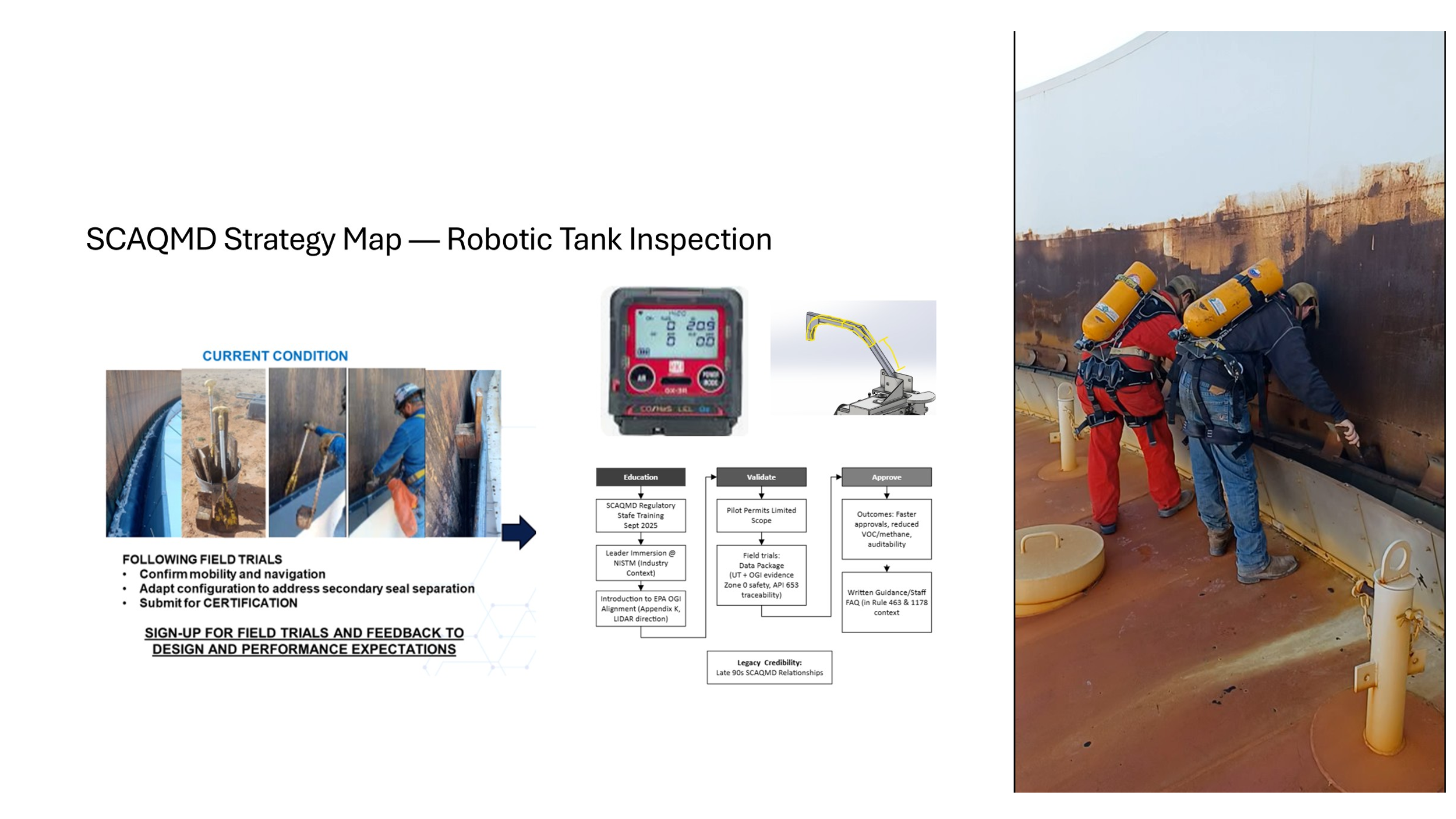
The white paper outlines a practical measurement methodology using pump-equipped, sample-draw multi-gas instrumentation with standardised sampling hose lengths and fixed circumferential station spacing. Methane is used as calibration gas, with a 500 ppm screening threshold serving as an early-indication benchmark for “attention required.”
Key controls include pre-use calibration documentation, consistent probe placement relative to the seal region, defined stabilisation dwell times per station, and systematic recording of wind speed, temperature, and roof position to contextualise variability. Data are captured in structured CSV format with timestamps, station identifiers, and environmental metadata.
The resulting dataset is not intended to replace geometric inspection records or permit-defined test methods. Its purpose is comparative and diagnostic: detecting localised seal degradation, prioritising targeted repairs, confirming post-repair improvement, and building a trendable performance baseline over time.
A Five-Phase Implementation Roadmap
To support practical adoption, the white paper presents a five-phase convergence roadmap. The first phase involves overlaying quantitative baselining onto a representative subset of tanks while leaving existing compliance obligations unchanged. Subsequent phases build toward trend analysis across seasons and operating states, integration of performance signals into maintenance planning, proactive regulatory engagement using the resulting dataset, and ultimately the institutionalisation of the method in standard work across contractors, shifts, and sites.
Safety and Cost Benefits
Beyond regulatory positioning, Valkim Technologies highlights meaningful safety and operational gains. Rim seal work occurs in elevated, potentially vapour-rich environments, and reducing the frequency of intrusive access tasks without reducing assurance has direct safety value. Targeted repair scheduling driven by performance data can also reduce outage scope and avoid uncertainty-driven contingency costs.
Corporate Governance Implications
The white paper closes with a governance argument particularly relevant for EU-anchored operators with US infrastructure. A consistent global doctrine, supported by auditable procedures and traceable datasets, allows companies to present a unified stewardship narrative to regulators, permit authorities, and ESG-focused stakeholders across jurisdictions. Rather than explaining why inspection practices differ by region, operators can state a single principle: mechanical integrity is maintained, and emissions performance is verified.
As Valkim Technologies summarises: “We comply, we verify, and we improve.”
For more information visit www.valkimtechnologies.com