


INA has marked the completion of the Rijeka Refinery Upgrade Project, representing the largest single investment in the company’s history and one of the biggest industrial investments in modern Croatia, with a total outlay of nearly EUR 700 million.
The completion of the Delayed Coking Unit and associated facilities brings the refinery’s installed processing capacity to up to four million tons of crude oil per year. The upgraded facility is now capable of processing a broader range of crude, including heavier grades, with a key focus on production optimisation. The new unit is expected to increase the share of diesel in total production by around 30 percent — a development of strategic importance to the market, particularly during Croatia’s peak tourist season.
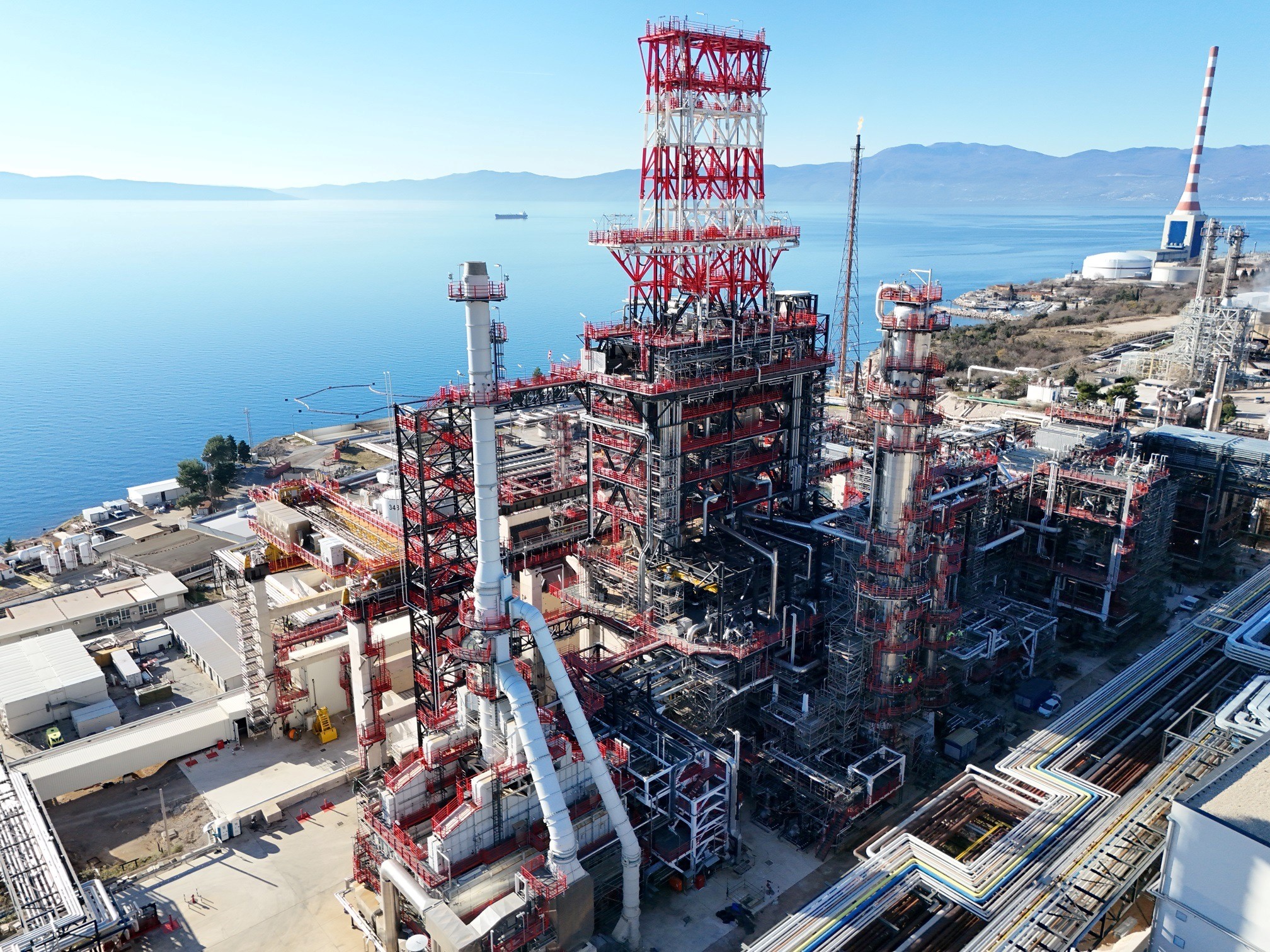 Rijeka Refinery: Source MOL
The upgrade also eliminates the need to import vacuum gas oil (VGO), which is predominantly of Russian origin on the European market, strengthening Croatia’s energy security and reducing its dependence on imported raw materials.
The completion ceremony was attended by representatives of the governments of Croatia and Hungary, ambassadors from several countries, regional and local community representatives, and the management of INA and MOL Group. Ahead of the ceremony, a Grant Agreement was signed with Croatia’s Ministry of Economy under the National Recovery and Resilience Plan for the construction of a green hydrogen production plant at the Rijeka Refinery, signalling the company’s continued commitment to sustainable development.
Zsuzsanna Ortutay, president of the management board of INA, described the upgrade as a strategic milestone, noting that the refinery would now be able to utilise every barrel of crude oil more efficiently and remain competitive for years to come. She highlighted that the benefits extend beyond the refinery itself, delivering greater energy security for Croatia and the region, more stable supply for customers, and a stronger position for INA as a regional supplier. Ortutay also noted that a commercial green hydrogen production plant — the first of its kind in Croatia — is set to be built on site before the end of the year.
Croatia’s Minister of Economy, Ante Šušnjar, underscored the project’s significance for national and regional energy security, stating that commissioning the Delayed Coker Unit marks a meaningful step forward in strengthening Croatia’s industrial sector. He called on the refinery to operate stably, sustainably and at full capacity, and reaffirmed Croatia’s intention to continue bolstering its energy infrastructure.
Hungary’s Deputy Minister of Foreign Affairs and Trade, Levente Magyar, framed the achievement in terms of shared regional energy sovereignty, emphasising that energy security in the region is indivisible and that the investment — which he described as of historical proportions — would serve as a guarantor of joint energy security, particularly in the current geopolitical climate.
József Molnár, CEO of MOL Group, acknowledged the completion of the construction phase while stressing that the work is only just beginning. He called on the refinery to become one of Europe’s most efficient, and reiterated MOL Group’s interest in a strong INA as a foundation for reliable energy supply across the region.
The scale of the project is illustrated by the construction figures: more than 10,000 tonnes of steel were used — equivalent to nearly one and a half Eiffel Tower structures, alongside 60,000 cubic metres of concrete, enough to build a medium-sized football stadium. More than half of the work was carried out by domestic contractors. The Rijeka Refinery upgrade forms part of a broader long-term investment cycle in which INA and MOL have committed more than EUR 1.3 billion to modernising refinery and logistics infrastructure over the past 12 years.
For more information visit www.mol.hu