

This year marks a remarkable milestone for the ConocoPhillips-operated Teesside Oil Terminal in the United Kingdom, as it celebrates 50 years of service. Renowned for its exceptional reliability and unwavering commitment to safety, the terminal has been a cornerstone of energy operations since its inception.
The journey began on 19 October 1975, when the first volumes of oil were transported through the 354-kilometre Norpipe Oil subsea pipeline from the Ekofisk field on the Norwegian shelf, across the North Sea, to the Teesside Oil Terminal on England’s northeastern coast. Over the decades, additional oil and gas fields from Norway and the UK have contributed to the Ekofisk blend, which the terminal processes, stores, and loads onto tankers with an impressive 99.99 percent uptime.

Situated at Seal Sands in Middlesbrough, the Teesside Oil Terminal has built a legacy of environmental excellence, earning recognition for its high standards in environmental management. The terminal’s diligence in monitoring, measurement practices, and cooperation with regulatory agencies underscores its commitment to sustainability.
Lee Murray, general manager at ConocoPhillips Holdings Ltd., highlighted the terminal’s significance, stating, “We are proud of our legacy and performance. Our reliability at the terminal is key to energy security.”
The site’s dedication to safety has also been a hallmark of its operations. Simon Leach, Health, Safety, Environment, and quality manager, emphasised this commitment, stating, “Our top priority is achieving zero injuries, ensuring everyone returns home safely. We are dedicated to upholding our high safety standards and fostering a secure, productive environment for everyone.”
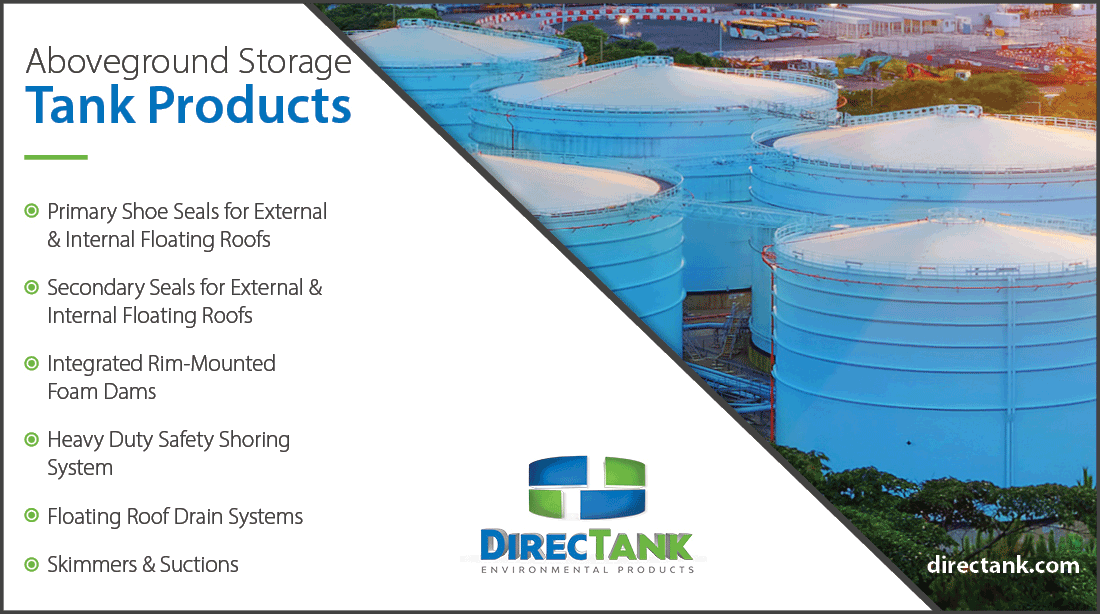
The terminal is home to approximately 260 employees and hosts around 300 contractors, with a daily workforce of about 500 people on-site. An additional 60 employees operate from the Wynyard office. Together, these teams manage the flow of volumes from offshore fields, oversee separation and stabilisation processes, and handle crude oil storage in nine tanks, each with a capacity of 640,000 barrels. They also coordinate offloading operations at the port’s jetty area, ensuring seamless transport of oil and natural gas liquids onto tankers.
Employees like Aaron Stallard exemplify the terminal’s emphasis on professional growth. Stallard began his career as an instrument and analyser technician after completing an apprenticeship. Balancing work and education, he earned a bachelor’s degree in electrical and electronic engineering before transitioning into leadership roles. Currently, he serves as project lead for schedule execution and budgets while pursuing a master’s degree in process safety and loss prevention. Reflecting on his journey, Stallard said, “I’m proud to work for a company focused on professional development and contribute to projects that transform and future-proof operations at Teesside.”
As the terminal looks to the future, it is nearing the completion of a state-of-the-art control room, replacing the on-site facility that has served for nearly five decades. Anne Willis, U.K. human resources manager, highlighted the upgrade, saying, “The new building, with its state-of-the-art control room, office, and meeting space, along with an improved social area, provides for a fantastic work environment. This upgrade reflects our commitment to continuous improvement and sets the stage for future success.”
With a legacy of excellence spanning five decades, the Teesside Oil Terminal continues to play a pivotal role in energy operations, combining innovation, reliability, and sustainability as it prepares for the next chapter in its history.
For more information visit www.conocophillips.com